The autonomous enterprise, run on outcomes.
State the outcome. Governed agents plan, act as far as you allow, measure and learn, with every decision on the record.
In short
What is an autonomous enterprise?
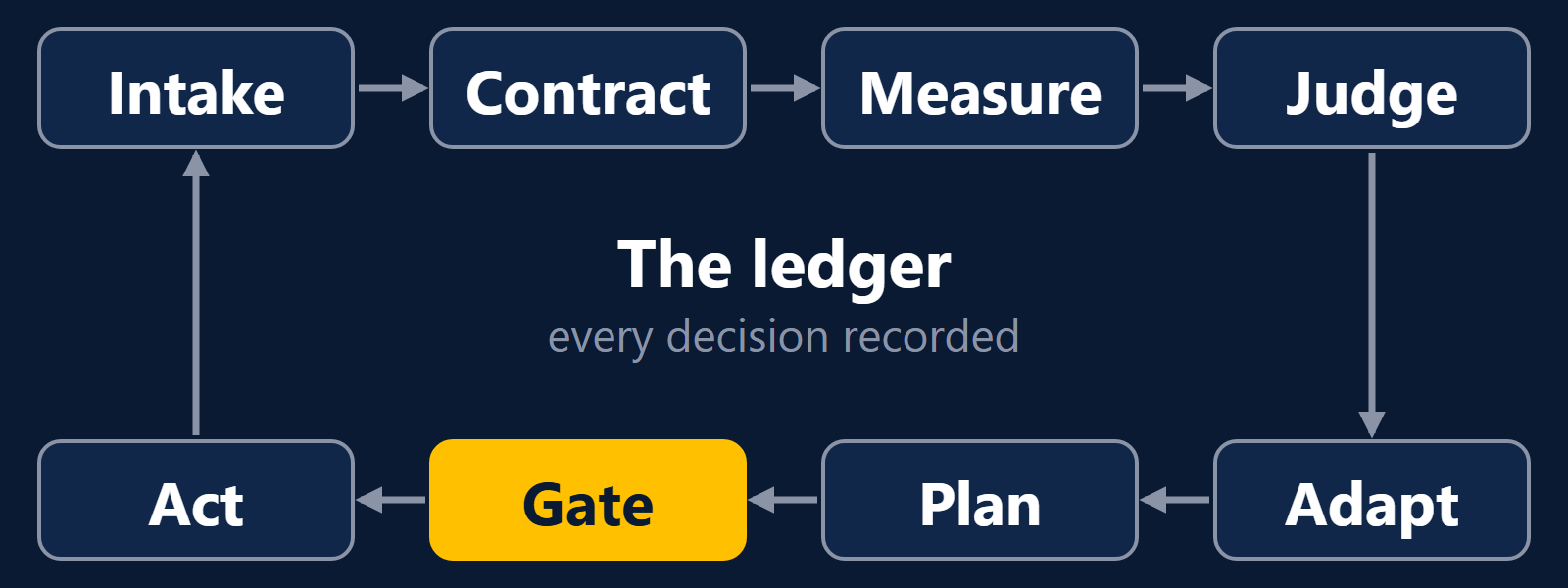
An autonomous enterprise states outcomes, and governed agents deliver them. On Saledge each outcome has a contract, a metric and a budget. Agents plan and act only as far as your policy allows, an independent judge confirms the result, every decision is recorded, and what worked becomes a skill.
Why now
Why this, why now
Autonomy is now a board question, and it needs an answer that holds up.
Boards want a strategy they can govern
An AI plan has to say who decides what, what it may spend and how anyone can check afterwards.
People expect agents in their work
Staff already use agents elsewhere. They expect them inside the systems where the work actually happens.
Improvising is not good enough
An agent that improvises at run time cannot be trusted with the decisions that matter. Limits have to be enforced, not requested.
The journey
From managed work to work that improves itself
Four stages: Manage, Automate, Decide, Learn. Each one stands on its own and prepares the next.
Manage
One system of record for content, data and work, with the same roles for people and tools. Saledge capability: composable content, commerce, forms and imports on a multi-tenant platform. Use case: a loyalty platform where members, points and rewards live in one place.
Automate
Repeatable work runs itself, and agents take steps inside it. Saledge capability: workflows with durable steps, named events, and signals and waits that hand work between people and agents. Use case: lender inbox routing, where each message becomes work in a team queue and overdue work escalates.
Decide
Agents make calls within limits you set, and something separate checks the result. Saledge capability: the outcome engine, with contracts, a gate by risk class and an independent judge. Use case: lender inbox triage, where hardship, complaint, legal, regulator and fraud mail is withheld from the model.
Learn
What worked is kept, and what did not changes the plan. Saledge capability: skills proposed from what worked, outcome experiments and metric-driven re-planning. Use case: a lender inbox response target, where each cycle measures the backlog and a reading can overturn the plan.
Decide the limits first, then let it run
Autonomy holds up when the shape of the work is settled before anything acts, and every action is checked as it happens.
At design time
App Builder assembles apps from platform building blocks, with a dry-run preview, approval and rollback. The content model guard keeps the data model sound.
At run time
The outcome gate wraps every tool call, and no prompt can talk past it. The ledger records each decision with its reasoning.
Our approach
Three pillars
What we mean by autonomous: as far as permitted, measured rather than self-reported, and explainable.
Governed autonomy
A gate by risk class, approval of the exact action, a budget, a kill switch and a ledger of every decision.
One platform for people and agents
Every capability is also a tool, under the same permissions. Agents connect over MCP and use skills, the tool atlas and A2A.
Modernise by outcome
Imports, code knowledge with citations and App Builder turn what you have into what agents can run.
By configuration
Configured on the platform, not bought separately
Four things that are often sold as separate products. On Saledge they are set up from what the platform already has.
Decisions that adapt
Outcome contracts re-plan each cycle from metric providers, with workflow conditions, experiments with variants and a forecasting tool the plan can call.
Case management
Work queues with assignment, claiming and routing, SLA timers that escalate overdue work, and queue metrics, set up as in the lender inbox use case.
Process visibility
Report Builder over your data, with the workflow run journal, the outcome ledger and the MCP access report showing what ran, why and who could do it.
Legacy modernisation
Imports with agent tools, code knowledge with citations, content model guard and repair, and App Builder to reassemble the application from platform building blocks.
Proof
What you can check for yourself
No analyst quotes and no customer logos, just things you can read and test.
This site
This website was built on Saledge, by agents, through the platform's own tools.
How agents connectA pilot outcome
Pick one result. We set up a sandbox tenant and run it with approvals on, so you can read every decision.
Ask for a pilotUse cases
From property matching to lender inbox triage, framed as outcomes you can run.
See the use casesFAQ
Questions people ask first
What makes an enterprise autonomous? +
Not the number of agents. Work is stated as outcomes with a contract, a metric and a budget. Agents act as far as you permit, results are measured rather than self-reported, and every decision can be explained.
How is this different from agents in a chat window? +
A chat answers and stops. An outcome has a contract, a gate on every tool call, an independent judge and a ledger. It keeps working until the contract is met, the budget runs out or you stop it.
Can agents act without approval? +
Only as far as your policy allows. By default, Read and Draft actions run alone; Write, Publish and External actions wait for approval of the exact action; Irreversible actions are denied. You can pause or stop an outcome at any time.
Which models? +
Bring your own: OpenAI, Azure OpenAI, Anthropic, or Ollama running on your own GPU. The gate and the ledger work the same whichever model plans the work.
Where do we start? +
With one result that matters. We set up a sandbox tenant, draft the contract with you and run it with approvals on, so you can read every decision in the ledger.
Run your first outcome with us.
Pick one result that matters. We draft the contract with you and run it with approvals on.